
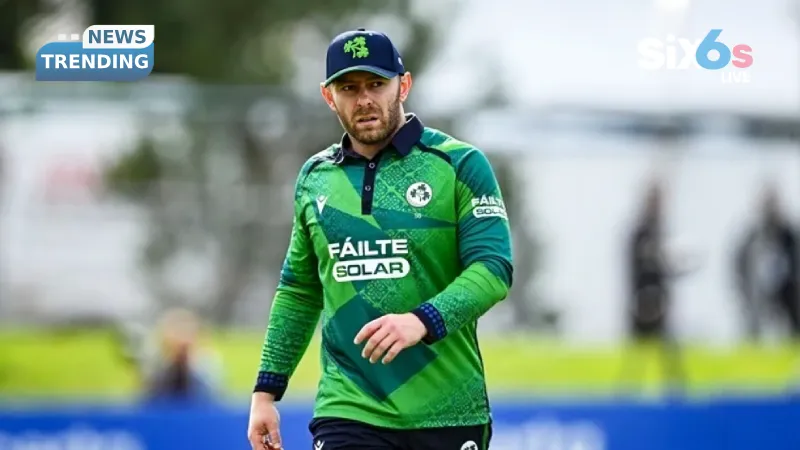
Ross Adair’s cricket journey is always an intriguing mix of charm and challenge, a blazing 58-ball century against South Africa in 2024, for example, followed by a painful knee and the inevitable rehab period. However, Ross Adair’s recent injury setback (a bone stress injury) that will keep him out of Ireland’s upcoming T20I matches against Bangladesh could not have come at a worse time for Ross Adair. At this point in 2025, Adair was building quietly on a consistent foundation: a 48 vs West Indies, two useful innings against England, and the look of a player who was transforming potential into production. This momentum has now been broken at the exact moment when Ireland is commencing their Asian examination tour. The loss of Ross Adair does not merely lose a hard-hitting opening batsman but also disrupts the balance that Ireland were beginning to perfect ahead of the 2026 T20 World Cup.
Jordan Neill: The Right Fit or a Rebuild Placeholder?
It appears Jordan Neill’s addition to replace Adair was more of an experiment brought about by circumstances rather than a replacement for Adair. Neill has been injured since his debut at the beginning of the year and provides some flexibility, but likely does not offer much firepower. He may help Ireland’s middle order control due to his red-ball temperament, but he replaces an explosive opener (Adair) with a stabilizer, so his presence is going to alter the way Ireland sets up their line-up for T20. Thus, the issue is not if Jordan Neill can bat; it is if he can create scoring opportunities for Ireland. In Mirpur, against Bangladesh’s attack that will be very heavy on spin, how well Neill adapts to the conditions will be more important than his batting identity. Additionally, Ireland is still trying to find a pair of openers that can be both aggressive and resilient, and this will remain a constant theme in their development as a team.
Calitz and the Middle-Order Variety Project
While Andrew White mentions Ben Calitz as somewhat incidental to his article, the inclusion of Ben Calitz is the pulse point of how Ireland is looking ahead for the future. As a left-handed middle-order batter, he can provide Ireland with something they have lacked for a long time, i.e., a natural counter to leg-spin and another way to create variety when setting up their sides in terms of opposition and match-up. In the last three years, Ireland’s middle order (Nos. 4-6) have averaged less than 22 runs per innings when facing spin in Asia. The inclusion of Calitz suggests that there may be some movement in the approach to planning from Ireland: this is not simply a matter of replacing an opening batsman, but rather a way of reconfiguring Ireland’s batting unit to be able to withstand the pressure and demands of different phases of a game.
Building Toward a World Cup With Broken Pieces
The bright side of Ross Adair’s Injury is that it gives Ireland’s management the chance to experiment with alternatives, which is one of the main reasons why elite T20 teams are successful. The variety of bowling styles and pitches on offer by Bangladesh (turning pitches, unpredictable bounce, and a crowd that can be hostile) will challenge not only Ireland’s batting style but also their mental toughness. Ireland may find a Plan B for these conditions beneficial in the future when it faces similar conditions in the West Indies in 12 months. However, there is still a sense of irony; Ireland’s most aggressive opening batsman will likely sit back and watch how his fellow teammates develop their ability to adapt, something he has done well for years.
The challenge of injuries tests how much a player believes in his team’s depth. In addition to testing Ross Adair’s body for injury, his absence will also be a first stress test for the team as they continue to prepare for the T20 World Cup. A creative batting line-up, patient selectors, and some good old-fashioned middle-order grit may be needed. Bangladesh’s playing conditions will certainly not have mercy on timid batters; however, they may offer a chance for Irish players to show their ability to adapt – something that many players are being forced to learn through necessity, almost by accident, and can potentially aid them in developing a better, more aware T20 cricket unit.
Stay updated on the latest cricket news and exciting updates at Six6slive. Dive into our in-depth articles and analyses to connect with the action today!